Showing posts with label SCA. Show all posts

Saturday, February 1, 2020

2020 SCA Birka Garb Challenge - Part 3

So ... Another Birka is in the books. I am constantly amazed at the range of creativity and talent seen in the range of Arts as well as everyday garb. But especially when it comes to the Garb Challenge. There were some truly amazing works.

But as this is MY page I am going to just focus on my outfit.

Here is a picture of my final outfit AND prop.


So here is some detailed information about the props.


I came up with the idea of having a tree in a pot come with me. in folklore the goddess Mielikki was married to an Oak Tree. Obviously, he would not be able to travel with me. So I noted to the audience that his "branch manager" was tasked to come with me. And yes, it is on wheels to roll with me.


On the tree are representatives of various forest animals such as bees, owls, squirrels, and a Norwegian Forest Cat. I also have a representative Orca along with two Guard Turtles and a local Lobster.


My thanks for Yona Carmichael for videotaping the various contestants. Here is my entry:


Monday, January 20, 2020

2020 SCA Birka Garb Challenge - Part 2

So Birka is this coming weekend and my garb is pretty much completed.


As this outfit was for a fantasy/mythology context I wanted to add an appropriate headdress. I found this headband with antlers at Savers as part of their Halloween costume offerins. I added glowers, fuit, vines and in the middle I attached a rubber otter.


I then turned to the overskirt. Last fall I had collected birch bark off a downed tree, then washed and pressed them. Using a translation program I took the goddess' name Meilliki and spelled it out in Runes. Then I traced the runes onto the birch bark and made applique piecess out of bark. These were appliqued down the right side of the apron. 


I added greenery and flowers to the bottom to highlight the connection this goddess has to the living and natural world.


This is the final decorated over apron dress. This was made from an old  wool Army blanket that came with the darker green stripe already woven into the material. it is merely cut to size and connected with pins at the shoulders to the matching back piece. I added additional chains, animal teeth and stones. Overall, this is one of the heaviest outfits I have ever made or worn.


Saturday, November 16, 2019

2019 SCA St. Eligius Competition

So I did complete at the St. Eligius event in Connecticut on November 19, 2019.

I expounded on what I did last year and tried to narrow my focus on types of food preservation methods - including showing some of my storing failures. They show that certain materials did not keep the food as fresh as others. Most of this had to do with the retention of moisture.

The other thing that did not work well for me had to do with temperature. For most of history foods stored in any type of Root Cellar all had one thing in common - consistent cool temps. However I do not have a completely unheated space so my produce got much warmer than it would in a traditional cellaring scenario.


Apples and Carrots in various mediums

Ready for Judging


Demonstrating freshness of this carrot

Additional informaiton about the rare orange produce


Overview
Must remember what I learned ....

Sample of wet and dry preservation techniques
Mid Presentation


I won the Food Category and received this golden amulet as a prize


Saturday, October 12, 2019

Breathing New Life into an Old Site

Back in February 2018 I was "downsized" from my job at Smith & Nephew, along with five other department members.

After months of job seeking it hit me - I really did NOT like what I had been doing and really did not want to take another job doing the same thing for years and years more.

I wanted to completely change my career.

So in September 2018 I began taking classes at Southern New Hampshire University to earm my Bachelors degree in Psychology, and then to work as an End of Life Doula working with Hospice patients.

During my studies I have written several papers, and created presentations, which I am rather proud of and wanted a place to share them.

So I have decided to resurrect this page as a place to not only mark scholastic items but to track my re-newed participation in the Society for Creative Anachronism (SCA).

Friday, October 11, 2019

2019 SCA Falling Leaves A&S Competition

So my forays into Medieval Foods continue. For this event I decided to narrow my focus to just one fruit and the various ways it could be preserved, cooked and used.

Peaches in Medieval Britain
Background:   In the modern produce section of many supermarkets consumers are accustomed to seeing a wide range of colors represented. Yet orange is still a minority color, seen in oranges, peaches, apricots and kumquats. As early as occupation of Britain by the Romans, peaches and apricots were available in the markets – many of them were most likely dried for transport.
Despite the availability of fruits there was still an opinion amongst doctors that they were bad for people, especially those that grew too close to the ground. However as the populace would not stop eating the fruit they could obtain some rules came into place to mitigate the “danger” of fruits.
Yet the peach has had the reputation for centuries of being an aphrodisiac, and the shape of fruit was said to suggest the female anatomy. These beliefs survived from Ancient Greece, China and then into Europe.

 
Fruit Beliefs at the time:
•Fruits classified as “cold” in Hippocratic medicine must be eaten at the beginning of the meal – Peaches fall into this category
•Fruits that grew on trees were considered better than those growing lower as they were closer to Heaven
•Fruit eaten raw was considered more dangerous than cooking it first
•Most very early recipes were found in Apothecary documents and not cookbooks.
Candied fruits and fruit jams could be served at the end of the meals as they were believed to close up the stomach and make digestion easier. .


  Dried:
•Drying foods, either under the sun or in an oven, is one of the oldest methods of preserving foods for long term storage.
•When preparing dried fruits for cooking it typically requires more preparation steps than fresh produce. Specifically, soaking it in boiling water for 10 minutes to partially re-hydrate the fruit before cooking it into a confit, compote or stewed mixture.

Fresh:
•Fresh peaches were available in parts of the Persian Empire around the Mediterranean, by 100 BC. Cultivation was still confined to the warmer climates of the Middle East and Northern Africa.
•By 800 AD fresh peaches were more readily available along the Northern African coast.
•Some of the oldest recipes I found using fresh peaches in the British Isles dated back to the late 15th century, as this appears to be the time frame when the fresh fruit became more readily available, but still on a limited basis.

Differences:

  I wanted to do this comparison to challenge modern perceptions about what people ate and to experience the differences between the extant and modern textures and flavors. 


I started with two versions of the peaches .... fresh and sun dried. I wanted to see the difference in textures and taste


Diced dried peaches soaked in boiling water then drained.


These were then mixed with candied ginger root then steeped together with local honey before being canned. I used a modern water bath method to reduce the risk of bacterial growth


Wednesday, October 9, 2019

Struggling with Perfection

A shared article in the Keepers of Athena's Thimble Guild page brought about a rambling muse ....


The Difference Between Embroiderers Yesterday and Today


Thank you SO much for sharing this post. This is an issue I have struggled with for decades and it still haunts me – at times even paralyzes me from sharing my work with anyone. Or even venturing to weekly or monthly get togethers I must confess.

I think it is very easy to see images shared by others and then our own work and feel we will never be “good enough”. Part of this may be human nature, we tend to share openly our best works and hide the learning pieces and flubs from anyone else’s eyes. I have a personal goal of earning competency in all 12 guild categories – but the idea of the lace ones keeps me paralyzed in “There is never any way I can do that”. It also is hard for me to see something at panel that the maker shrugs off with “it is not my best and it took over a two weeks to do…..”. I would love one day to hear the maker say something along the lines of “Thank you – this is actually my 23rd time trying to do this – the first ten I just set fire to outside they were such a tangled mess!”

I am not against striving to be as good as we can be, and I understand the need of having a standard to aspire to. I am just regularly disheartened when the only things I see are “too” perfect and actually look machine made. This also stops me from showing some of my work, the comments that “such and such would not have been done in period …” I want to ask those who say this … “How do you know? Just because we have no pictures of a woman doing X, and textiles from the 11th century did not survive outside a few rare snippets … can you prove that they DIDN’T do this? Can you honestly tell me that nowhere in the history of the world did a woman not sketch out something she saw and did her best to replicate that image in needle and thread?”

At this point part of my brain is screaming at me to apologize for airing my feelings. But when organizers of A&S Displays wonder why they have light participation perhaps how I feel is how others feel. When you attend an event, take the time to read the artist notes. Creators – write down why you did what you did – what is the story? Leave an encouraging comment or token, thank the person for sharing their work and passion.

So now I go back into my shell and work on my non-period-provable projects that I will enjoy but may never be seen outside of my home. Because despite what people think they know about me from the casual public contact we may have had – I can be hurt very easily and am scare of exposing my work to the raised eyebrow and elegant sniff from one of the “Perfection Patrol”. 


Friday, September 27, 2019

2019 SCA St. Eligius Competition Prep - part 1

Some pictures showing the pre-work in food preservation that I will be displaying in November at the competition in Connecticut.


 2019 St. Eligius Competition prep: Experiment in storing root vegetables. They are completely covered with the medium and located on the lower level of my townhouse where it is coolest as I do not have a root cellar. From Left to Right: Sand, Straw, Sawdust


2019 St. Eligius Competition prep: Storing Apples - base is sawdust, then straw, apples, more sawdust and completely covered with straw.


2019 St. Eligius Competition prep:Ongoing test of carrots in the back and apples in the front to test liquid preservation methods. All produce was canned raw with no seasonings, salt or spices. From left to right:
  1. 1) Produce in vinegar, modern water bath canning method to form air-tight seal
  2. 2) Produce in vinegar - sealed with wax
  3. 3) Produce in vinegar - closed only with a lid/cover
  4. 4) Produce in honey - closed only with a lid/cover


2019 St. Eligius Competition prep: I did experimental preservation of orange peels. Done with sugar on the left and honey on the right.

Tuesday, September 10, 2019

Making SCA garb - 05

This is the second re-make of the ethnic garb I purchased at a local yard sale.

For this one - the outfit's pants were an exact fabric match to the tunic. So I opened the tunic side and sleeve seams as well as completely disassemble the pants. Luckily the pant's angles had matching trim to the sleeves so I could make the adjustment seem more like an original concept.


I did remove the bottom Paisley embellishment as I felt it made the outfit more fitting for everyday wear.


Serving the Head Table at the Feast for Harper's Retreat in 2019


Sunday, August 25, 2019

2020 SCA Birka Garb Challenge - Part 1

This year's Garb Challenge was announced ..


His Highness and I would like to invite you all to join us in this 
year's Garb Challenge for Birka. Put on your thinking and research hats, because we hope you will enjoy getting creative with this year's theme: MYTHOLOGY! Any Pantheon! Any culture! All styles! 


So after considering several cultures I settled on a Finnish Goddess with her outfit based in the Iron Age.


"Mielikki is the Finnish goddess of forests and the hunt. She is referred to in various tales as either the wife or the daughter-in-law of Tapio, and the mother of Nyyrikki and Tuulikki. She is said to have played a central role in the creation of the bear."

First image of Mielikki used for inspiration


Woven ribbon I chose for the triple wrap belt for the over apron


        The plan is to adorn the ends with Iron Age/Viking Age wire coils at each end. So I carefully unwove about a foot at each end in preparation to attach the coils once I made them


Traditional and Ancient ways of wearing adornments varied from region to region and differed from Norse Viking groups. The Finns had the two amulets that secured the overdress but there was a center medallion or brooch over the breastbone. Most of these stones came from my stash as did the center pin (Originally gifted to me by Amy Lindsay). I really like the bone center piece that I found in a jumble box.


Monday, March 11, 2019

Making SCA Garb - 04

Sometime in the Spring of 2018 I had gone to a Yard Sale where the man had lost his wife and was downsizing in preparation of selling his house.

Included in what he was selling were his wife's clothing. I am not sure if the family was from India or a neighboring country, but her clothing was amazing in color and workmanship. He told me each had been made just for her - as such there was little to no seam allowances. But I loved the tunic structure of the top piece and they came with matching, or coordinating, pants and scarves.

So I bought two, then went back a month later for more. This is the first one I tackled.


This gown did not have matching pants, but they were in a solid color. However I had in my stash a green batik material that was a very close match.

In order to make this so it fit me I carefully unpicked both side seams from hem to underarm. I then removed the seam from armpit to wrist. into these open spaces I could now add strips of the batik to widen the sleeves and body of the tunic.


Here are a couple of examples of me wearing the finished outfit. The batik matches so well that most people do not realize it is not original.

The headscarf is the original that came with the tunic and pants. For this outfit I made a necklace as well using green stones.


Saturday, February 9, 2019

2019 SCA Embroidery Schola

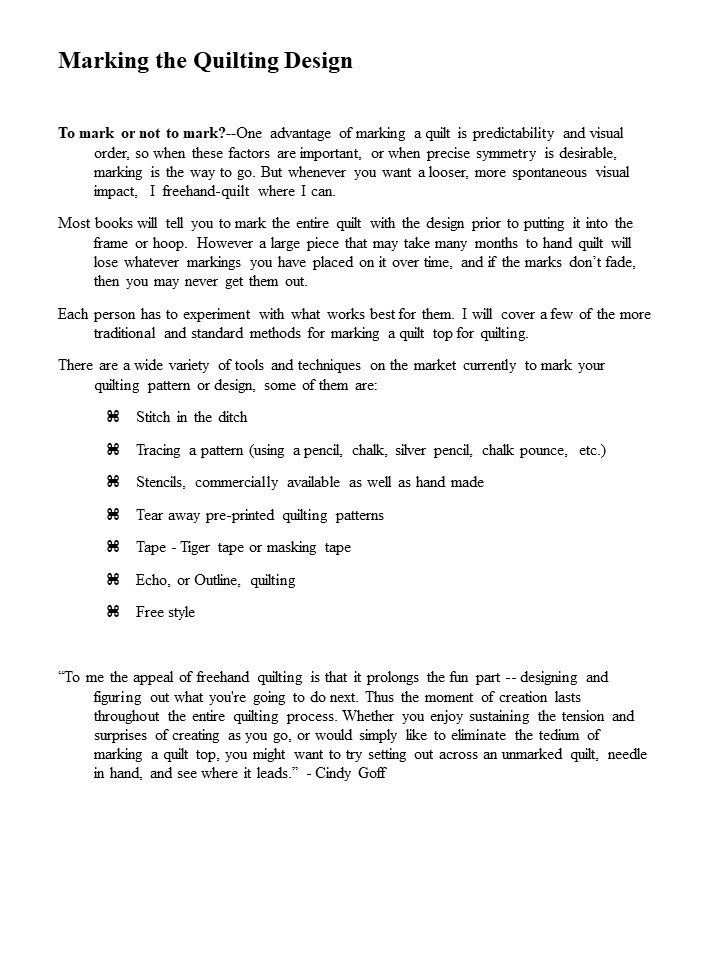
My first time teaching basic hand quilting techniques to SCA needleworkers. These are my handouts which is a combination of my prior teaching through a work program, added to with more time appropriate examples.


Saturday, November 10, 2018

2018 St. Eligius Arts & Craft Competition


This was my first experience with this competition held annually in Connecticut. Here is some of the information I presented to the populace and the judges.


St. Eligius’ 12 Questions Contest Documentation

1.) What did you make or do? (Include name or description of entry with time period, location, info on its use & background.)

           
My entry consists of two types of preserved produce: Pickled vegetables and some stewed fruits.

2.) What is the connection between your entry and a medieval item or practice?

          I have been preserving foods for over 20 years for my own use and gifts. As in medieval times I preserve produce when it is season for use and access during the times when fresh fruits and vegetables would not be available.

3.) How would your entry have been made/done in period?

          Large crocks of pottery or even wooden kegs would be used to hold pickled or salted vegetables for later use. The fruits would have been either dried or stored in honey and spices in jars and sealed with either a natural material or a bit of cloth. Fruits would be stewed in wine or honey with spices before placed into pots. But in period the fruits would have used more in a medicinal use and not as we do for our morning toast.

4.) How was yours made/done?

          I used a wine that had turned for my acidic vinegar base and experimented with available spices for the 12th – 13th century. Where as I typically use a processed dark or white sugar – or sugar substitute – for my modern jams I used only local honey for this entry. 

5.) What are some similarities and differences in materials, process, tools, approach?

          I chose to not make examples that were cured, or layered, in salt for personal taste and health reasons. The process itself is rather simple and most likely has not changed that much over the centuries. However, in order to ensure food safety I water bath canned my food in glass jars where that process was not available until the 1800s. I can during various times of the year – preferably when I am able to either pick my own produce or buy it in season from a local farm which is what would have been done in period as they would have had little chance in many places to purchase out of local season produce.

6.) What inspired you? (Try to have an image of period example or related item and description, webaddress, or citation for image source)

          As I have been doing this activity for myself for years it was an easy step to look at doing it in a more medieval manner once I became involved with the SCA. 

7.) What was your favorite part of preparing your entry?

          Experimenting with the different flavor combinations.

8.) What would you do differently next time? (imagine yourself advising someone beginning to do what you’ve done)?

          For the beets I would have simmered them in the vinegar and seasonings – some of the flavor of the veggies does not come through when raw. I also will crush some of the whole spices before adding them next time. Some of the flavors were too subtle overall.

9.) What references or sources would you recommend to someone interested in your work? (You can bring your book(s)&/or copies of articles so people can make notes about your sources.)

  1. http://www.oldcook.com/en/medieval-fruit
  2. http://www.bl.uk/learning/langlit/texts/cook/medieval/medieval2.html
  3. http://www.theoldfoodie.com/2006/10/english-peach.html
  4. http://www.lordsandladies.org/middle-ages-food-fruit.htm
  5. http://www.medievalists.net/2015/06/medieval-beekeeping/
  6. http://www.oldcook.com/en/medieval-spices
  7. https://www.thoughtco.com/medieval-food-preservation-1788842
  8. https://www.thoughtco.com/medieval-food-preservation-1788842
  9. http://www.florilegium.org/?http%3A//www.florilegium.org/files/FOOD/pickled-foods-msg.html
  10. http://www.godecookery.com/allrec/allrec.htm#top

 10.) How did you find your sources of information?

          I started reading a couple of blogs from various SCAdians who reference some of the websites noted above. Those sources then led me to a couple of direct translations of a few “recipes”.

11.) Did you find a connection to a medieval artisan or owner while working on your entry?

          Not specifically. I have felt in touch with all the women who have gone before me though every year when I am canning. I feel that I am carrying on a tradition of all those who have prepared food to feed their families throughout the winter.

12.) Any last thoughts or amusing stories about your work?

          Not at this time.